Imagine a sudden fall at the park or a sports injury that leaves you holding your own tooth in your hand. The panic is real, and the questions hit all at once. Is it gone forever? Should you head to the ER or a dentist? We understand how overwhelming a knocked out tooth emergency Lowell families face can be. It’s not just about the physical pain; it’s the stress of permanent tooth loss and the uncertainty of what to do next.
The good news is that acting quickly can often save your natural smile. This guide shares the exact steps you need to take during the “golden hour” to keep the tooth viable. You’ll learn how our Lowell team uses VideaHealth AI diagnostics to provide fast, accurate assessments when every second counts. We’ll walk you through the latest 2026 clinical guidelines so you can move from panic to a professional solution with total confidence.
Key Takeaways
- Discover the essential “Golden Hour” steps you must take to preserve a tooth’s root and improve the success rate of reimplantation.
- Learn why seeking care for a knocked out tooth emergency Lowell families encounter is best handled by a dentist rather than a traditional emergency room.
- Find out how we use VideaHealth AI diagnostics to spot subtle injuries and guide the restoration of your smile with clinical precision.
- Understand the proper way to handle and store a dislodged tooth to keep vital tissues alive while you’re on your way to our office.
- Explore modern restorative solutions like dental implants that provide a durable and natural-looking replacement if a tooth cannot be saved.
Immediate Steps for a Knocked-Out Tooth in Lowell
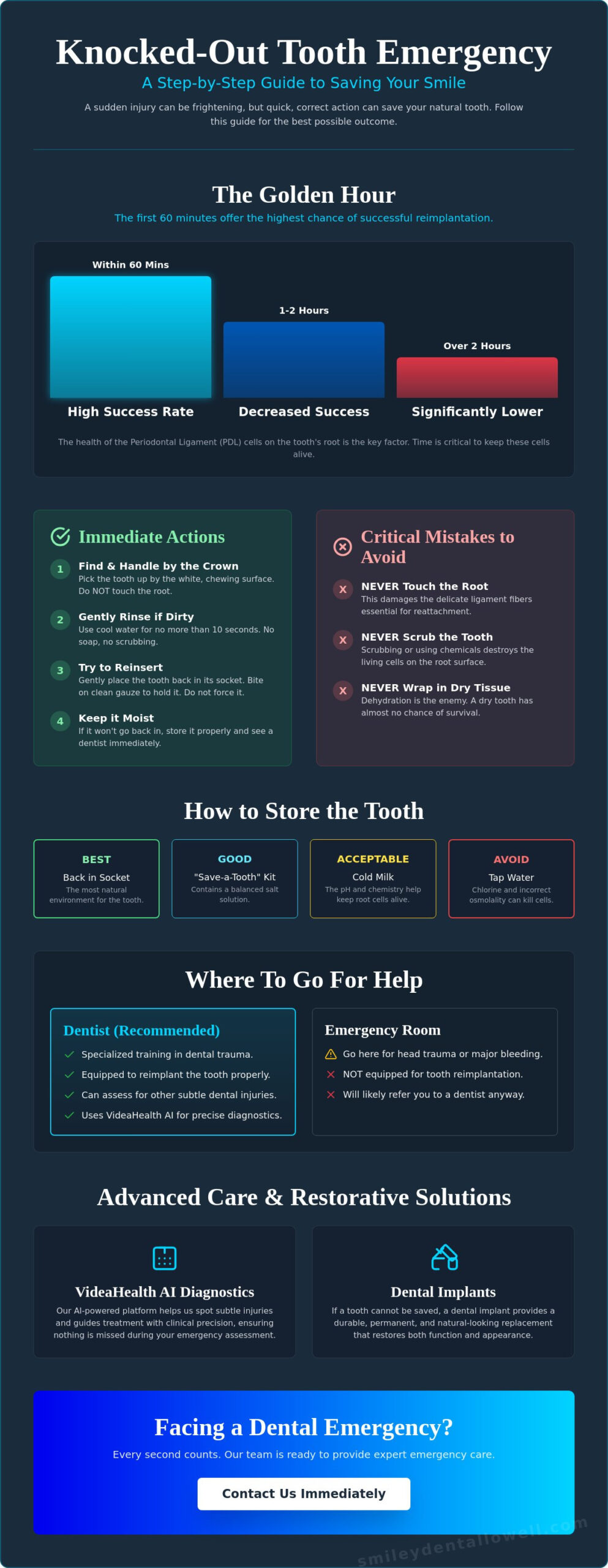
When a dental injury happens, your first reaction is often shock. We know how frightening it is to see a tooth knocked out, but managing a knocked out tooth emergency Lowell families might face requires a cool head and quick reflexes. The moments immediately following the injury are the most important for the future of your smile. First, find the tooth. Once you’ve located it, pick it up by the crown, which is the white, chewing surface. Avoiding the root is the single most important thing you can do to keep the tooth alive.
If the tooth looks dirty, give it a quick, gentle rinse with cool water for no more than ten seconds. Don’t use soap, chemicals, or any scrubbing tools. If you’re able, try to place the tooth back into its original socket immediately. You can hold it in place by gently biting down on a clean piece of gauze or a soft cloth. This keeps the root in its natural environment and protected from the air. If the tooth won’t go back in easily, don’t force it. Instead, focus on keeping it moist until you reach our office for your knocked out tooth emergency Lowell care.
The “Never” List: Handling a Dental Avulsion
A Dental avulsion is a serious injury where the tooth is completely displaced from its socket. To give your tooth the best chance of survival, you must follow a few strict rules. To avoid common mistakes that lead to permanent tooth loss, keep these “nevers” in mind:
- Never touch the root; the tiny fibers called periodontal ligaments are delicate and essential for reattachment.
- Never scrub or scrape the tooth to “clean” it, as this destroys the living cells on the root surface.
- Never wrap the tooth in a dry tissue or cloth; dehydration is the enemy of a successful reimplantation.
Preservation Liquids: Why Milk Matters
If you can’t put the tooth back in the socket, you need the right storage medium. Cold milk is the preferred option because its pH balance and chemical makeup mimic the natural environment of your mouth. This helps the cells on the root stay healthy for a longer period while you travel to the dentist. While tap water might seem like an easy fix, it’s actually a last resort. The chlorine in tap water can damage the root cells, and the lack of proper osmolality can cause the cells to burst. If you have a “Save-a-Tooth” kit in your school or home first aid supplies, use the balanced salt solution provided there. Otherwise, a small container of milk or even your own saliva will work until you arrive for treatment.
Understanding the Golden Hour: Why Time is Critical
In the world of dental trauma, time is the ultimate factor. We often refer to the first sixty minutes after an injury as the “Golden Hour.” During this brief window, the chances of successfully reimplanting a tooth are at their highest. Once you pass that 60-minute mark, the clinical success rate begins to drop. If a tooth remains outside the mouth for more than two hours, the likelihood of the body accepting the tooth back into the socket decreases significantly. This is why reacting quickly to a knocked out tooth emergency Lowell families experience is so vital. It isn’t just about the physical tooth; it’s about the microscopic life still clinging to its surface.
Biological Survival of the Periodontal Ligament
The key to a successful recovery is the health of the periodontal ligament (PDL). You can think of the PDL as the living “anchor” that holds your tooth in place. It consists of thousands of tiny, sensitive fibers that connect the root of the tooth to the jawbone. When an injury occurs, these cells are suddenly cut off from their blood supply and exposed to the environment. Dehydration causes these cells to die within minutes. An avulsed tooth is defined as the complete displacement of a tooth from its alveolar bone socket. To keep these cells alive, you must follow the immediate steps for a knocked-out tooth, such as keeping the tooth moist in milk or saliva. If the PDL cells die, the tooth cannot properly fuse back to the bone, which often leads to the body rejecting it as a foreign object.
What if You Exceed the 60-Minute Window?
If you can’t reach a dentist within the first hour, don’t give up. While the “Golden Hour” offers the best prognosis, we can still attempt to save a tooth that has been out for longer. In these situations, our team at Smiley Dental Lowell uses specific delayed reimplantation protocols. We treat the root surface to remove dead cells and prepare the socket for a second chance. It’s likely that a tooth out for an extended period will eventually need Root Canal Therapy. This procedure removes the damaged internal pulp to prevent painful infections from developing later. While the long-term outlook for a delayed reimplantation is more cautious, many patients successfully keep their natural teeth for years with the right professional intervention and follow-up care.
Dental Emergency vs. ER: Where to Go for Your Injury
When you’re dealing with a knocked out tooth emergency Lowell families often feel torn between rushing to the nearest hospital or calling their dentist. It’s a high-stakes decision. While hospital emergency rooms are excellent for general trauma, they aren’t usually equipped to handle dental reinsertions. Most ER physicians focus on stabilizing life-threatening injuries; they don’t have the specialized training or tools to reimplant a tooth or apply a dental splint. Visiting an ER for a dental injury often results in long wait times and a prescription for pain relief, but the tooth itself might be lost during the delay.
Choosing a dedicated dental practice ensures you get the right care immediately. For any knocked out tooth emergency Lowell residents may face, we prioritize these visits because we understand that every minute counts toward saving your natural smile. Our team has direct access to the specific materials needed to stabilize your tooth and the advanced imaging to check for underlying damage. By coming directly to us, you bypass the crowded hospital waiting room and get straight into a chair where a professional can begin the work of saving your tooth.
When to Choose the Emergency Room
There are specific times when the hospital is the correct choice. If your dental injury is accompanied by signs of a fractured jaw or a concussion, you need a medical evaluation first. Seek immediate help at an ER if you experience uncontrollable bleeding that won’t stop with pressure. Other red flags include severe facial swelling that makes it hard to breathe or swallow. If you have deep cuts on your face or lips that require stitches, the ER is better prepared to handle those soft tissue repairs. Once your medical condition is stable, you can then follow up with us for the dental restoration.
Why a Lowell Emergency Dentist is Best for Tooth Saving
A specialized dental office offers technology that most general hospitals simply don’t have on hand. We utilize Digital X-Rays and VideaHealth AI Diagnostics to look deep into the bone and surrounding tissues. This AI technology helps us detect tiny fractures or issues that might be missed by the human eye during a stressful emergency. This precision is vital for successful reimplantation. You can find expert advice on saving a tooth from the American Association of Endodontists, which confirms that specialized dental care is the gold standard for trauma.
Beyond the initial fix, our team provides the essential long-term follow-up care that an ER cannot offer. We monitor the tooth over the following weeks to ensure it’s healing correctly and that no infection is developing. We also handle the transition from emergency stabilization to permanent solutions, whether that involves root canal therapy or future restorative work. Our goal is to provide a seamless, stress-free experience that prioritizes both your physical comfort and the long-term health of your smile.
Advanced Emergency Care at Smiley Dental Lowell
When you walk through our doors with a knocked out tooth emergency Lowell, our priority is to move quickly while keeping you completely comfortable. The treatment process begins with a thorough assessment to understand the extent of the trauma. We use digital X-rays to look at the root and surrounding bone, but we take it a step further by integrating VideaHealth AI into our diagnostics. This technology helps us detect subtle issues that might not be visible to the human eye, such as hairline fractures in the jaw or damage to the roots of adjacent teeth that also took part of the impact.
Once we’ve assessed the area, we begin the reimplantation process. We carefully clean the tooth socket to remove any debris or blood clots that might interfere with healing. The tooth is then gently placed back into its original position. To ensure you remain relaxed during this urgent visit, we offer various comfort-focused options and sedation to alleviate any anxiety. Our goal is to make the experience as stress-free as possible while we work to restore your smile. If you are experiencing a crisis right now, our team is ready to provide Emergency Dental Care with the compassion and precision you deserve.
VideaHealth AI: Precision in Trauma Assessment
AI technology has changed the way we handle dental trauma. By analyzing your digital images, the AI can flag potential problem areas with incredible accuracy. This is especially important for checking neighboring teeth that may have suffered “silent” trauma, which often goes unnoticed until a much larger problem develops later. VideaHealth AI diagnostics provide a “second set of eyes” for faster, more accurate emergency treatment.
The Splinting and Healing Process
After the tooth is back in its socket, it needs a way to stay there while the ligaments reattach. We use a splinting technique where we bond the injured tooth to the healthy teeth next to it using a thin, flexible wire or resin. This acts like a temporary cast for your tooth. Typically, this splint stays in place for two to four weeks depending on the severity of the injury. During this time, you’ll need to follow a few simple rules to protect the area:
- Stick to a soft food diet to avoid putting pressure on the stabilizing tooth.
- Brush very gently around the splint to keep the area clean without disturbing the bond.
- Avoid using the injured tooth for biting or chewing until the splint is removed.
We’ll schedule follow-up visits to monitor your progress. During these appointments, we check for signs of infection or root resorption, a process where the body mistakenly begins to dissolve the tooth root. Catching these signs early allows us to intervene with treatments like Root Canal Therapy to save the tooth long-term.
Restoring Your Smile: Solutions After Dental Trauma
Sometimes, even with the fastest response to a knocked out tooth emergency Lowell families provide, a tooth simply cannot be successfully saved. This might happen due to extensive damage to the root or if the “Golden Hour” passed before professional treatment could begin. While this news is difficult to hear, modern dentistry offers incredible ways to restore your smile so it looks and functions just like it did before the accident. We’re here to guide you through these choices with a focus on your long-term comfort and confidence.
Our team understands that a missing tooth affects more than just your appearance; it impacts how you eat, speak, and feel about yourself. We take a patient-centric approach to every restoration, ensuring that the solution we choose together fits your lifestyle and your health goals. Whether we’re stabilizing a saved tooth or planning a replacement, we use high-quality materials designed to last for years.
Replacement Options for Missing Teeth
When a tooth is lost, comparing dental implants in Lowell, MA to traditional bridges is a common part of our restorative process. Dental implants are often considered the gold standard because they replace the root of the tooth. This helps preserve your jawbone and provides a permanent, standalone solution that doesn’t affect neighboring teeth. If an implant isn’t the right fit for your needs, a fixed dental bridge can effectively fill the gap by using the teeth on either side for support.
For teeth that were saved but suffered chips or cracks during the trauma, high-quality porcelain crowns can be used to reinforce the structure and match the natural color of your surrounding teeth. The timeline for these permanent restorations usually begins after the initial trauma has fully healed, which ensures a stable foundation for your new smile. We’ll monitor your healing closely to determine the perfect moment to move forward with these final touches.
Insurance and Financial Support for Emergencies
We believe that financial stress shouldn’t stand in the way of urgent dental care. One of our core values is radical transparency regarding the costs of treatment. It’s reassuring to know that Smiley Dental accepts most insurance plans, and our administrative team works directly with your provider to maximize your benefits. This helps reduce out-of-pocket costs during an already stressful time.
For our neighbors in the Lowell community who don’t have dental insurance, we offer flexible payment structures to help make emergency care and follow-up restorations more manageable. We prioritize your immediate relief and physical health first, ensuring you aren’t left in pain while navigating logistics. We’ll always provide a clear, easy-to-understand breakdown of your options and any costs before permanent restorative work begins. This neighborly approach builds the trust you need to feel confident in your care journey.
Secure Your Smile with Fast, Expert Care
A dental injury is a stressful event, but you now have the tools to handle it with confidence. Remember that the “Golden Hour” is your best opportunity for success. By handling the tooth by its crown and keeping it moist in milk or saliva, you’re already halfway to saving your smile. While the hospital ER is vital for general trauma, a specialized dentist is your best advocate for reinserting and stabilizing a tooth. Managing a knocked out tooth emergency Lowell residents face is a race against time, and our team is here to help you win it.
At Smiley Dental Lowell, we combine a neighborly touch with advanced technology like VideaHealth AI-enhanced trauma diagnostics to ensure the highest level of care. We guarantee same-day emergency appointments for urgent trauma and accept most insurance plans to keep your care accessible. You don’t have to navigate this alone. Call Smiley Dental Lowell Now for Emergency Care: 978-999-9000. We’re ready to help you restore your smile and your peace of mind today.
Frequently Asked Questions
Is a knocked-out permanent tooth a dental emergency?
Yes, a knocked-out permanent tooth is a critical dental emergency that requires immediate professional attention. To save the natural tooth, you must act quickly to preserve the living tissue on the root. We treat these cases as a top priority to give you the best chance of a successful reimplantation and to prevent long-term complications like bone loss or infection.
Can a dentist put a knocked-out tooth back in successfully?
Yes, we can often successfully reimplant a tooth if it remains healthy and hasn’t been out of the socket for too long. Success depends heavily on how you handle the tooth before you arrive at our office. By using VideaHealth AI diagnostics, our team can precisely assess the socket and surrounding bone to ensure the best possible environment for the tooth to reattach and heal properly.
How long can a tooth stay out of the mouth and still be saved?
The “Golden Hour” is the 60-minute window where reimplantation has the highest success rate. While some teeth can still be saved after this period, the chances drop significantly as the root cells begin to die from dehydration. Seeking treatment for a knocked out tooth emergency Lowell within 30 to 60 minutes is the best way to protect your natural smile and ensure a positive outcome.
What should I do if I cannot find the tooth that was knocked out?
You should still visit us immediately even if you can’t find the tooth. We need to examine the injury site for jawbone fractures, nerve damage, or any small tooth fragments that might be left in the gum. Once we’ve ensured the area is stable and healthy, we can discuss modern restorative options like dental implants or fixed bridges to replace the missing tooth and restore your function.
Does dental insurance cover emergency tooth reimplantation?
Most dental insurance plans provide coverage for emergency services, including tooth reimplantation and stabilization splints. Because individual policies vary, our administrative team will work directly with your provider to help you maximize your benefits. We prioritize transparency in our financial process so you can focus on your recovery without worrying about the logistics of your coverage.
What is the best liquid to keep a knocked-out tooth in?
Cold milk is the best common liquid for storing a tooth because its chemical makeup and pH balance help keep the root cells alive. If milk isn’t available, you can use a tooth preservation kit or even keep the tooth in your mouth next to your cheek. Don’t use tap water for storage, as the chlorine and incorrect osmolality can cause the sensitive root cells to burst and die.
Can a baby tooth be put back in if it is knocked out?
No, you shouldn’t attempt to reimplant a knocked-out baby tooth. Reinserting a primary tooth can accidentally damage the permanent tooth that is still developing underneath the gum line. Even though the tooth shouldn’t be put back, you should still bring your child in for an emergency exam to check for other injuries to the mouth or jaw that might need attention.
How much does an emergency dental visit cost in Lowell without insurance?
The cost of an emergency visit depends on the specific treatments and diagnostic imaging required to stabilize your injury. We understand that unexpected dental costs can be stressful, which is why we offer flexible payment structures for our neighbors in Lowell who are currently without insurance. We’ll always provide a clear, low-pressure explanation of any costs before we begin your restorative care.