
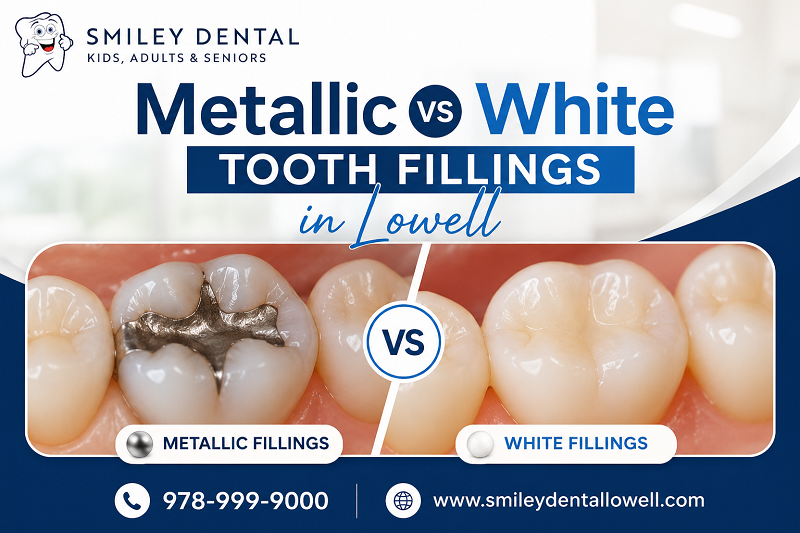
If you have ever opened wide in a photo and spotted a dark patch at the back of your mouth, you have met a metallic filling. For decades it was simply what a filling was. Nobody offered you a choice.
Today you have one, and the honest answer is not as one-sided as most dental websites make out. This guide compares both materials fairly, tells you what the evidence actually says about mercury, and helps you work out which suits your tooth, your budget, and your smile.
What Is a Metallic Tooth Filling?
A metallic tooth filling, properly called dental amalgam, is an alloy of mercury blended with silver, tin and copper. Dentists have used it for more than 150 years, which makes it one of the most studied materials in medicine.
It is packed into the prepared cavity and hardens in place. It does not bond to the tooth, so your dentist has to cut a slightly larger, undercut shape to lock it in mechanically. That is the hidden cost of amalgam: you lose a little more healthy tooth to hold it.
Where Amalgam Still Earns Its Place
- It is the cheapest filling material available.
- It is extremely strong under heavy chewing forces.
- It tolerates moisture better, which helps in awkward back-tooth spots.
- Evidence suggests it lasts slightly longer than composite on average.
What Are White Fillings?
White fillings are made from composite resin, a blend of plastic and fine glass particles that is shade-matched to your enamel. The resin is applied in layers and hardened with a curing light, and it bonds chemically to the tooth. Our tooth-coloured fillings are one of the most requested treatments at our Lowell practice.
Because it bonds, your dentist only needs to remove the decay itself rather than cutting a retention shape. More of your natural tooth stays where it belongs. Bonding also seals the tooth, which tends to mean less temperature sensitivity afterwards.
Metallic vs White Fillings: Side by Side
Here is the honest comparison, including where amalgam genuinely wins.
| Factor | Metallic (Amalgam) | White (Composite) |
| Appearance | Dark and clearly visible | Matches your natural teeth |
| Mercury content | Yes, in alloy form | None |
| Bonds to the tooth | No, held mechanically | Yes, chemically bonded |
| Healthy tooth removed | More | Less |
| Typical lifespan | 10 to 15 years | 7 to 12 years |
| Cost | Lowest | Moderate |
| Sensitivity afterwards | More common | Usually less |
| Best for | Large back-tooth cavities | Visible teeth, small to medium cavities |
Is the Mercury in Metallic Fillings Safe?
This is the question everyone actually wants answered, and it deserves a straight response rather than a scare story designed to sell you composite.
What the Evidence Says
The American Dental Association’s position is that amalgam remains a safe, effective and inexpensive restorative option. The FDA, the World Health Organization and the EU have all reviewed the evidence and concluded that the mercury vapour released from amalgam fillings is extremely low and does not cause adverse health effects in the majority of people. This is not a fringe view. It reflects more than a century of research.
Who the FDA Suggests Avoid It
That said, in 2020 the FDA recommended that amalgam be avoided, where mercury-free alternatives are available, for certain groups:
- Pregnant women and those planning to become pregnant
- Nursing mothers and their newborns or infants
- Children, particularly those under six
- People with pre-existing neurological conditions such as multiple sclerosis, Alzheimer’s or Parkinson’s
- People with impaired kidney function
- People with a known allergy or sensitivity to mercury or other amalgam components
If you fall into one of those groups, say so at your appointment. It is a sensible, evidence-based reason to choose composite, and no dentist should argue with you about it.
Should You Replace Fillings You Already Have?
Important: do not rip out healthy fillings The FDA is clear that removing intact amalgam fillings is generally unnecessary unless there is a medical reason. Fillings in good condition do not pose significant health risks, and drilling one out removes healthy tooth structure and briefly releases more mercury vapour than leaving it alone ever would. If a metallic filling is sound, leave it. Replace it when it fails, cracks or decays underneath, or if you simply dislike how it looks and accept that the swap is cosmetic.
So Why Is the World Moving Away From Amalgam?
Mostly for the planet, not the patient. The Minamata Convention on Mercury, adopted in 2013 and in force since 2017, set out to phase down dental amalgam because of environmental mercury pollution rather than any finding of harm to patients. The EU went further and banned amalgam for general use from January 2025, with narrow exceptions for documented medical need. In the United States, the EPA has required dental practices to fit amalgam separators since 2017 to keep mercury out of the water supply.
The other driver is simply what patients want. Nobody asks for a dark filling on a tooth that shows. Between aesthetics and environmental policy, composite has quietly become the default, and the materials keep improving.
| Not sure which filling suits your tooth? A quick exam gives you a straight answer and a written estimate. Call Smiley Dental Lowell on 978-999-9000 or request an appointment online. |
Teeth Filling Colours: How Shade Matching Works
The reason a good white filling disappears is that it is not simply white. Composite comes in a wide range of teeth filling colours, and your dentist selects the shade against a guide held next to your tooth, in natural light where possible.
Enamel is not one flat colour either. It is slightly translucent, usually darker near the gum and brighter at the biting edge. A skilled dentist layers different shades and opacities to imitate that, which is why two dentists using the same material can produce very different results. Matching your teeth natural colour is as much craft as chemistry.
- Shades are chosen before your teeth dry out, since dehydrated teeth look temporarily lighter.
- Front-tooth work often uses several shades layered together.
- Composite can pick up mild staining over the years, though a polish usually refreshes it.
How Much Do Fillings Cost?
Price depends on the material, the size of the cavity and how many surfaces of the tooth are affected. Typical 2026 figures:
| Filling Type | Typical Cost Per Tooth | Notes |
| Metallic (amalgam), one surface | $100 to $250 | The cheapest option |
| Metallic (amalgam), multi-surface | $150 to $350 | Larger back-tooth cavities |
| White (composite), one surface | $150 to $300 | Most common choice |
| White (composite), multi-surface | $200 to $450 | Larger or front-tooth work |
| Inlay, onlay or crown | $800 to $2,000 | When a filling would be too big |
Figures are 2026 national estimates drawn from ADA fee survey data and published provider pricing. Your exact quote is confirmed at your visit.
Good news on coverage: because a filling treats decay, most plans classify it as restorative rather than cosmetic and cover a share of the cost. Some plans reimburse composite only at the amalgam rate, leaving you the difference on back teeth. We file claims for most major providers and are in-network with a variety of PPO plans and MassHealth, and patient financing is available if you need it.
| Expert Dental Tip Get the order right. Bleaching gel only lightens natural enamel, so it has no effect on a composite filling. If you are considering whitening, do it first and let your teeth settle for a fortnight, then have the filling matched to your new brighter shade. Fill first and whiten afterwards, and you are left with a filling that suddenly looks too dark and cannot be bleached to catch up. |
Which Should You Choose?
Run through these and the answer usually appears:
- Does the tooth show when you smile? Then composite, without much debate.
- Is it a large cavity in a back molar taking heavy load? Amalgam is a perfectly respectable choice, and cheaper.
- Are you pregnant, nursing, or in one of the FDA groups? Choose composite.
- Is budget the deciding factor? Amalgam costs less. A filling you can afford beats a cavity you leave untreated.
- Do you want to keep as much natural tooth as possible? Composite, because it bonds rather than needing a retention shape.
One more thing worth knowing: sometimes neither is right. If decay has reached the nerve, you may need root canal treatment first. And if the cavity is so large that a filling would leave the tooth fragile, dental crowns and bridges give far better long-term strength. An honest dentist tells you when a filling is not enough.
Beyond Fillings: The Rest of the Natural-Look Toolkit
The same thinking that replaced metal fillings has spread across dentistry. If your teeth are crooked, tooth coloured braces use ceramic brackets shaded to blend in, and Invisalign clear braces go further with removable, near-invisible aligners. For chipped or stubbornly discoloured front teeth, porcelain veneers reshape the smile entirely, and professional teeth whitening brightens natural enamel.
If a tooth is beyond saving, dental implants replace it with a titanium post and a colour-matched crown. The principle is consistent throughout: modern materials that do the job without announcing themselves.
Why Choose Smiley Dental Lowell
A filling is only as good as the hand placing it, especially when shade matching is involved. Our Lowell team includes dentists educated at Harvard, Boston University, the University of Michigan and the University of Minnesota, among them a dentist recognised with the Academy of Operative Dentistry Award for Outstanding Achievement in Operative Dentistry, which is precisely the discipline that covers fillings, and a colleague who earned honours in Oral Surgery and Periodontics.
We have been named among America’s Best dentists in recent years. Our multilingual team offers Saturday appointments, we are in-network with a variety of PPO plans and MassHealth, and we care for patients across Lowell, Tyngsborough, Methuen, Chelmsford, Tewksbury and Pelham.
The American Dental Association advises adults to visit the dentist at least every six months. Routine dental cleanings and exams catch decay while it is still a small filling rather than a crown, which is the cheapest dentistry there is.
The Bottom Line
There is no villain in this story. Metallic fillings are safe, cheap and durable, and they still make sense for a large cavity in a back tooth or a tight budget. White composite fillings look like your own teeth, contain no mercury, bond to the tooth and preserve more of it, which is why they have become the everyday standard.
If you have a cavity, the worst choice is neither material. It is waiting. Decay only travels in one direction, and a filling today is always simpler and cheaper than a crown or a root canal next year.