It is the question we get asked more than any other about whitening, usually phrased the same way: does it wreck your enamel?
It is a fair worry. Enamel does not grow back, and the internet is full of confident people with strong opinions and no evidence. So rather than reassure you and move on, here is what the actual research shows, including the bits that are genuinely worth knowing before you book.
What the Evidence Actually Says
The concern about enamel has been studied properly, and the picture is reassuring.
A 2026 systematic review and meta-analysis, conducted to PRISMA standards and pooling data from 81 laboratory studies, examined what peroxide bleaching does to the surface hardness of human enamel. It found statistically detectable but small reductions in microhardness, with no clear evidence of clinically meaningful effects. The authors concluded that peroxide bleaching appears unlikely to cause meaningful harm to enamel integrity when used according to recommended protocols, and that the evidence supports its continued clinical use.
Longer-term clinical data points the same way. Follow-up studies extending to three years report no significant lasting damage to enamel, dentine or the pulp. The minor changes that do show up, such as transient surface demineralisation, are reversible and do not weaken the tooth.
| The honest caveat Every one of those findings comes with the same condition attached: when used according to recommended protocols. The American Dental Association is explicit that overuse of whiteners can damage enamel or gums. Whitening is not dangerous. Whitening done badly, too strong, or too often is. That distinction is the whole point of seeing a dentist rather than a stranger at a shopping-centre kiosk. |
What Whitening Is Doing Inside Your Tooth
Understanding the mechanism explains both the results and the side effects. Peroxide gel does not scrub or bleach the surface the way household bleach does. It diffuses through the enamel and breaks apart the stain molecules trapped in its microscopic pores. Our teeth whitening services use this same chemistry, controlled properly.
The part most articles skip is that the peroxide does not stop at the enamel. It carries on through the dentine and reaches the pulp, the living tissue inside your tooth that holds the nerve. Once there it triggers a mild inflammatory response. That is not a malfunction. That is simply what the material does, and it happens with take-home trays as well as in-office gel.
This is why teeth feel sensitive afterwards, and also why the effect is temporary. The inflammation settles, and the tooth returns to normal.
Sensitivity: The Side Effect Worth Taking Seriously
If a dentist tells you whitening never causes sensitivity, find another dentist. A 2023 systematic review found that between 43 and 80 percent of patients experience temporary tooth sensitivity after peroxide whitening. That is a wide range, reflecting differences in gel strength, how long it is left on, and individual susceptibility.
It typically peaks in the first 24 to 72 hours and fades within a few days. It is uncomfortable rather than harmful, and crucially it is manageable.
How We Reduce It
- Desensitising agents. Potassium nitrate or fluoride, used before and after, measurably reduce sensitivity.
- Starting two weeks early. A desensitising toothpaste in the fortnight before treatment makes a real difference.
- Adjusting the dose. With trays you simply shorten the wear time or skip a day. You cannot do that with a fixed-strength strip.
- Choosing the right gel. Carbamide peroxide is gentler and can be as effective as hydrogen peroxide for some patients.
- Spacing treatments. Professional whitening is generally advised every 6 to 12 months, not whenever you fancy it.
The Risks, Honestly Assessed
Here is every realistic risk, how likely it is, and what a dentist does about it.
| Risk | How Likely | What We Do About It |
| Temporary sensitivity | Common, 43 to 80 percent | Desensitisers, adjusted dose, spacing |
| Gum irritation | Uncommon in-office | Protective barrier over the gums |
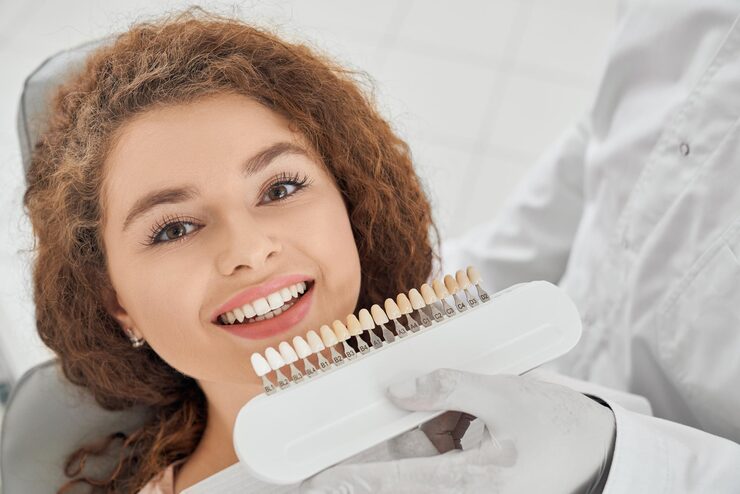
| Uneven or patchy result | Rare with custom trays | Shade recorded, trays moulded to your teeth |
| Enamel harm | Not shown at recommended protocols | Correct concentration, supervised timing |
| Mismatched restorations | Certain, if you have them | Whiten first, then match the restoration |
| Harm from overuse | Real, and avoidable | We set the schedule, not the packaging |
Why a Teeth Bleaching Dentist Is the Safety Feature
The gel is not really the variable. The supervision is. A teeth bleaching dentist controls four things that no shop-bought kit can:
- A health check first. Whitening over an undiagnosed cavity or inflamed gums is a genuinely bad idea. That check is the single biggest safety difference.
- Gum protection. A resin barrier is placed before any strong gel touches your teeth. This is why in-office concentrations of 25 to 40 percent are safe in a clinic and would not be at home.
- The right concentration. Matched to your teeth and your sensitivity, rather than whatever the box contained.
- Someone watching. If your teeth respond unusually, the protocol changes. Nobody is monitoring a strip.
It is worth noting the flip side too. A 2023 review found low overall evidence regarding the effectiveness and safety of over-the-counter whitening agents. That is not the same as saying they are dangerous. It means nobody has properly established what they do.
| Want an honest assessment before you commit? A short consultation tells you whether whitening will work for your teeth, and whether it should wait. Call Smiley Dental Lowell on 978-999-9000 or request an appointment online. |
Who Should Wait, or Skip It Altogether
Safe for most people is not the same as safe for everyone. We would advise holding off if you:
- Have untreated decay or active gum disease. Treat it first, always.
- Have exposed roots or significant gum recession, which whiten unpredictably and hurt.
- Have cracked teeth or leaking fillings, where gel can reach places it should not.
- Are pregnant or breastfeeding. There is no evidence of harm, but elective cosmetic treatment can simply wait.
- Are under 18, or still have baby teeth in the mix.
- Already have severe sensitivity, until we work out why.
This is why a dental exam comes before any gel. It is not an upsell. It is the step that keeps whitening in the safe column.
Why a Dentist Cleaning Teeth Comes First
Here is a small thing that makes a surprising difference. Gel cannot work evenly through a layer of plaque and tartar, so having a dentist cleaning teeth beforehand is part of the treatment rather than an optional extra. A professional dental cleaning removes the buildup and lifts a fair amount of surface staining on its own.
Some patients are genuinely happy after the clean alone and decide they do not need bleaching at all. We are fine with that. It is the cheapest whitening result there is, and we would rather tell you than sell you something you do not need.
| Expert Dental Tip If your teeth feel sensitive during a course of take-home trays, do not push through it as if it were a test of character. Stop for a day or two, use a desensitising toothpaste, then resume with shorter wear times. The final shade will be the same. Pain is not the price of a whiter smile, and treating it as such is exactly how people end up with problems. |
What Whitening Cannot Do
Safety aside, the other honest limitation is what bleach simply will not touch. Gel only lightens natural enamel. Porcelain and gold are unaffected by it entirely, so dental crowns and bridges, porcelain veneers and the crowns on dental implants keep their original shade. Composite fillings may shift very slightly, but not enough to rely on.
A single tooth that has darkened after trauma will not respond to external whitening either. That usually needs root canal treatment followed by internal bleaching or a crown. And if your real complaint is that your teeth are crooked rather than yellow, Invisalign clear braces will do far more for your smile than any gel.
Why Choose Smiley Dental Lowell
Safe whitening comes down to who is holding the syringe. Our Lowell team includes dentists educated at Harvard, Boston University, the University of Michigan and the University of Minnesota, among them a dentist recognised with the Academy of Operative Dentistry Award for Outstanding Achievement and another holding a Master of Public Health from Harvard, whose background shapes a strong emphasis on prevention and evidence over fashion.
We have been named among America’s Best dentists in recent years. We offer both in-office and custom take-home teeth whitening procedures, our multilingual team runs Saturday appointments, and we care for patients across Lowell, Dracut, Chelmsford, Tewksbury, Billerica, Tyngsborough and Methuen.
If you would like the practical detail on options, pricing and results rather than safety, our companion guide to professional teeth whitening costs and what to expect covers all of it.
The Bottom Line
Professional teeth whitening is safe. That is not marketing, it is what a meta-analysis of 81 studies and three years of clinical follow-up data support. Your enamel will be fine.
What you should expect is a few days of sensitivity, and what you should avoid is overuse, unregulated gels, and whitening over problems that need treating first. Those caveats are exactly what a dentist manages for you. The safest whitening is not the gentlest product on the shelf. It is the one applied by someone who checked your mouth first and knows when to say wait.
| Have a question about whitening? Ask us before you buy a kit. Call Smiley Dental Lowell on 978-999-9000, request an appointment, or contact our Lowell office at 1141 Bridge St. Saturday appointments are available, and new patients are always welcome. |