| Quick Answer Full mouth dental implants replace a whole arch of missing teeth with a fixed set of teeth anchored on four to six implants. In 2026 they cost about $14,000 to $36,000 per arch, and the full process takes roughly 3 to 6 months, mostly healing time. Your timeline depends on extractions, bone grafting, and how you heal. Careful planning is what makes the result strong, natural, and long-lasting. A consultation gives you a personalized plan and quote. |
Living with missing or failing teeth, or dentures that slip and click, wears on you. Eating, speaking, and smiling all become a source of stress instead of joy.
Full mouth dental implants offer a permanent, natural-feeling solution: a fixed set of teeth anchored securely to your jaw. This guide covers what they are, what they cost in 2026, the step-by-step procedure, and what recovery really looks like, so you can decide if they are right for you. It is part of comprehensive full mouth reconstruction care.
What Are Full Mouth Dental Implants?
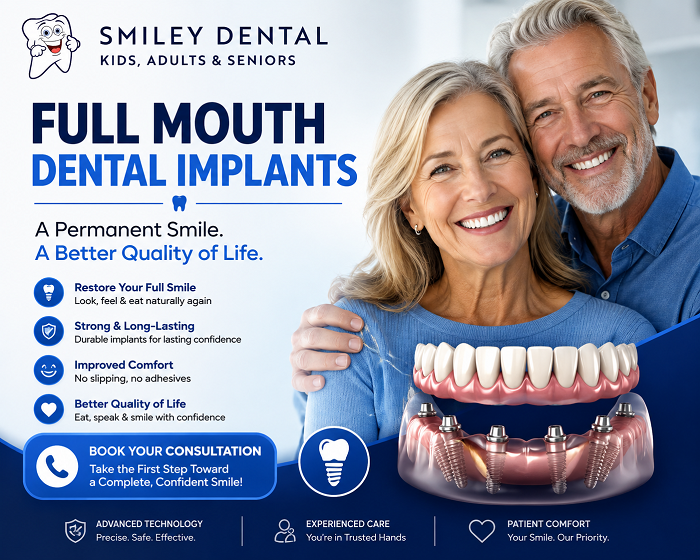
Full mouth dental implants replace an entire arch of missing teeth using four to six titanium posts placed in the jaw, topped with a custom, non-removable set of teeth. The posts fuse with your bone, giving a stable, permanent foundation that looks and works like natural teeth.
How They Differ From Traditional Dentures
Unlike removable dentures that rest on the gums and can slip, implant teeth are fixed in place. They do not move, do not need adhesive, and let you eat almost anything. They also preserve the jawbone, which conventional dentures do not, so your face keeps its natural shape.
How They Differ From Single-Tooth Implants
A single implant replaces one tooth with one post and one crown. Full mouth implants replace a whole row using just four to six implants to support a complete bridge, rather than one per tooth. This makes the per-tooth cost far lower, even though the total is higher.
Common Types
- All-on-4: a full fixed arch on four implants, often the most cost-effective option.
- All-on-6: uses six implants for added support, helpful in some cases.
- Implant-supported overdenture: a denture that snaps firmly onto two to four implants, a lower-cost middle ground.
How Much Do Full Mouth Dental Implants Cost?
Full mouth dental implants typically cost $14,000 to $36,000 per arch in 2026, so replacing both the upper and lower teeth commonly totals $28,000 to $72,000. The wide range reflects the number of implants, the materials, and any preparation like extractions or bone grafting.
Cost by Component
The price covers more than implants. It includes the titanium posts, the abutments, the custom prosthetic arch, the surgery, sedation, and imaging. A full-arch acrylic bridge sits at the lower end, while a premium zirconia arch costs more.
What Affects the Price
- Number of implants, such as All-on-4 versus All-on-6.
- Prosthetic material, with acrylic costing less than zirconia.
- Bone grafting or extractions, which can add $5,000 to $14,000 or more.
- Your location and the dentist’s experience.
Cost Comparison
| Option | Typical Cost (per arch) | Notes |
| All-on-4 (acrylic) | $15,000 to $25,000 | Fixed, most cost-effective |
| Fixed arch (zirconia) | $24,000 to $36,000 | Premium, most durable |
| Implant overdenture | $7,000 to $13,500 | Removable, snaps on |
| Conventional denture | $300 to $3,000 | No implants, rests on gums |
Figures are 2026 national estimates. Per-arch prices often exclude grafting, extractions, and imaging. Your quote comes from a personalized exam.
How Much Does ClearChoice Cost?
Patients often ask about national chains like ClearChoice. Based on independent reports, it is commonly cited at about $20,000 to $36,000 per arch, or roughly $40,000 to $60,000 for both arches, at the premium end. A local practice can often provide comparable fixed-arch care, so it is worth comparing quotes.
Does Insurance Cover Full Mouth Implants?
Most dental insurance does not fully cover implants, though some plans help with part of the cost, such as extractions or the prosthetic. Coverage varies widely, so it is worth checking. Our team can review your insurance and payment options and explain financing that spreads the cost into monthly payments.
Are Full Mouth Dental Implants a Good Idea?
For most people with multiple missing or failing teeth, yes. Implants are the closest thing to natural teeth, restoring full chewing power, clear speech, and a confident smile.
They also protect your health. By preserving the jawbone and letting you eat a full, nutritious diet, they support your whole body. While the upfront cost is significant, implants can last decades, making them a strong long-term value. You can weigh this in our guide to whether dental implants are worth it.
Full Mouth Implants vs Dentures vs Bridges
Each tooth replacement option fits a different need and budget. Here is how they compare:
| Factor | Full Mouth Implants | Dentures | Bridges |
| Stability | Fixed, permanent | Removable, can slip | Fixed, tooth-supported |
| Chewing power | Like natural teeth | Limited | Good |
| Bone preservation | Yes | No | No |
| Lifespan | 20+ years, often lifelong | 5 to 8 years | 10 to 15 years |
| Maintenance | Brush and floss normally | Remove and soak | Special cleaning |
| Upfront cost | Highest | Lowest | Moderate |
Dentures cost the least upfront but need replacing and do not stop bone loss. Bridges work well for a few missing teeth. Implants cost the most initially but last the longest and feel the most natural. For a fuller comparison, see our guide to tooth replacement options in Lowell.
The Full Mouth Dental Implant Procedure, Step by Step
The process spans several months and unfolds in clear stages. Here is what to expect from start to finish:
- Consultation and imaging. A 3D CT scan and exam map your bone and nerves so the dentist can plan precisely.
- Tooth extraction, if needed. Any remaining failing teeth are removed, often on the same day as surgery.
- Bone grafting, if needed. If your jaw needs more support, a graft rebuilds it, which adds healing time.
- Implant placement surgery. Four to six posts are placed per arch under sedation, often with a temporary set of teeth the same day.
- Healing and osseointegration. Over 3 to 6 months, the implants fuse with your bone while you wear the temporaries.
- Final teeth attached. Once healed, your custom permanent arch is fitted and adjusted for a comfortable bite.
Because healing varies from person to person, your dentist gives you a personalized timeline rather than a fixed promise.
| Want a personalized cost estimate? The team at Smiley Dental Lowell can evaluate your smile and build a plan and quote around your needs. Call 978-999-9000 or request an appointment online. |
Full Mouth Dental Implants in a Day: Is It Really Possible?
Yes, in a sense. Same-day or teeth-in-a-day protocols like All-on-4 place the implants and a temporary set of teeth in a single surgical appointment, so you leave with a full smile that day.
How Same-Day Implants Work
The implants and a temporary fixed arch go in during one visit. Your permanent arch is still made and fitted 3 to 6 months later, after the implants fully fuse with the bone. So the smile is immediate, but the final teeth still require healing time.
Who Qualifies
Same-day treatment suits patients with enough healthy jawbone and good overall health. Not everyone qualifies, which is why a thorough CT-scan evaluation comes first.
The Limits of Rushing
The one thing that cannot be rushed is osseointegration. Loading permanent teeth before the bone has fused risks failure, so the staged approach protects your long-term result even when temporaries go in on day one.
Recovery Timeline: What to Expect After Surgery
Full healing takes 3 to 6 months, but the toughest part is short. Here is the general recovery arc, keeping in mind that healing varies:
- First 24 to 72 hours. Swelling and discomfort peak, managed with prescribed pain relief and cold compresses. Rest and eat soft, cool foods.
- First 2 weeks. Swelling fades and most people feel much better. Stick to soft foods and gentle cleaning.
- 1 to 3 months. Osseointegration progresses quietly. You wear your temporaries and attend adjustment visits.
- 3 to 6 months. The implants finish fusing, and your permanent teeth are placed. You return to a normal diet.
Tips for Faster Healing and Foods to Choose
Follow your dentist’s instructions, avoid smoking, keep the area clean, and rest early on. Eat soft, nourishing foods like smoothies, soups, eggs, and yogurt at first, and avoid hard, crunchy, or very hot foods until cleared. Staying hydrated and eating well speeds recovery.
Risks, Side Effects, and Complications
Full mouth implants have a high success rate, generally above 95 percent in healthy patients, but like any surgery they carry some risk.
- Common side effects: swelling, bruising, and mild discomfort for a few days, all normal and temporary.
- Rare complications: implant failure or infection, which are uncommon and usually treatable when caught early.
- How to reduce risk: choose an experienced dentist, follow aftercare, avoid smoking, and keep up with checkups.
Smoking is the single biggest controllable risk factor, since it slows healing and raises the chance of failure.
Are You a Good Candidate for Full Mouth Dental Implants?
Many people with extensive tooth loss are candidates. You may be a good fit if the following describe you:
| ✓ You are missing most or all of your teeth in one or both arches ✓ You are tired of loose, uncomfortable dentures ✓ You have enough healthy jawbone, or are open to a graft ✓ You are in reasonably good general health ✓ You do not smoke, or are willing to quit during healing ✓ You want a permanent, natural-feeling solution |
Patients with significant bone loss may need a graft first, and conditions like uncontrolled diabetes are addressed before surgery. Age itself is rarely a barrier. A comprehensive exam confirms whether implants are right for you.
How to Choose the Right Dentist or Clinic
This is a major investment in your health, so choosing the right provider matters. Keep these points in mind:
- Ask about experience: how many full-arch cases they have done and to see before-and-after results.
- Check credentials and technology: 3D imaging and digital planning lead to more predictable results.
- Understand the full quote: confirm whether it covers extractions, grafting, sedation, and the permanent teeth, not just the temporaries.
- Watch for red flags: pressure to decide instantly, prices that seem too good to be true, or vague answers about what is included.
Frequently Asked Questions
The implant posts can last a lifetime for many patients, while the prosthetic arch of teeth may need replacing after 15 to 20 years or more. Good hygiene and regular checkups are what make them last. This lifespan far exceeds dentures or bridges.
The surgery is done under sedation and local anesthesia, so you feel no pain during it. Afterward, discomfort is usually milder than patients expect and settles within 3 to 7 days with prescribed pain relief. Most people are pleasantly surprised by how manageable recovery is.
Often yes. Many patients with bone loss still qualify, sometimes after a bone graft to rebuild support, or by using techniques like tilted implants that work with available bone. A CT scan during your consultation shows exactly what your jaw needs.
Both anchor a full fixed arch, using four or six implants respectively. All-on-4 is often more cost-effective and works well for many patients, while All-on-6 adds two implants for extra support in cases with more bone or greater chewing demands. Your dentist recommends the right one for you.
Care for them much like natural teeth: brush twice a day, clean underneath the bridge as shown, and see your dentist for regular checkups and cleanings. There are no special soaks or adhesives. Good daily habits are what keep them healthy for decades.
Failure is uncommon, with success rates generally above 95 percent in healthy patients. When it happens, it is usually linked to smoking, uncontrolled health conditions, or poor hygiene. Following aftercare and attending checkups keeps the risk very low.
In 2026, expect about $14,000 to $36,000 per arch, or $28,000 to $72,000 for both arches, depending on materials and whether you need grafting or extractions. A personalized quote after an exam is the only way to know your exact cost.
Most plans do not fully cover implants, though some help with parts like extractions or the prosthetic. Coverage varies, so it is worth verifying your benefits. Financing options can make treatment more affordable by spreading payments over time.
Key Takeaways
- Full mouth dental implants replace a full arch with a fixed, natural-feeling set of teeth on four to six implants.
- They cost about $14,000 to $36,000 per arch in 2026, with the total depending on materials and prep work.
- The process takes 3 to 6 months, most of it healing, though temporaries can go in on day one.
- They last decades and preserve jawbone, unlike dentures or bridges.
If missing or failing teeth are holding you back, full mouth dental implants can give you back a confident, functional smile for the long term. The best first step is a consultation with a 3D scan for a precise plan and a clear quote. Book with Smiley Dental Lowell to explore your options. Call 978-999-9000 or request an appointment online today.
| Rebuild your smile with confidence. Book a full mouth dental implant consultation at Smiley Dental Lowell for a personalized plan and quote. Call 978-999-9000 or request an appointment online. Find us at 1141 Bridge St, Lowell. New patients are always welcome. |