
| Quick Answer
A single surgical dental implant in Massachusetts typically costs $3,000 to $6,000 in 2026, including the titanium post, abutment, and crown. The full process usually takes 3 to 9 months, because the implant needs time to fuse with your jawbone. If you need an extraction or bone graft first, expect closer to 9 to 12 months. Your exact timeline depends on your bone health, healing, and treatment plan. |
How much do surgical dental implants cost in Lowell, and what does the procedure actually involve? A single implant generally runs $3,000 to $6,000 in Massachusetts, and the process typically spans several months from consultation to final crown.
This guide covers each stage of treatment, who qualifies, what affects your timeline, an itemized cost breakdown, how insurance handles implants, recovery expectations, and the risks worth knowing. If you are weighing dental implants in Lowell against other options, here is what to expect.
What Are Surgical Dental Implants?
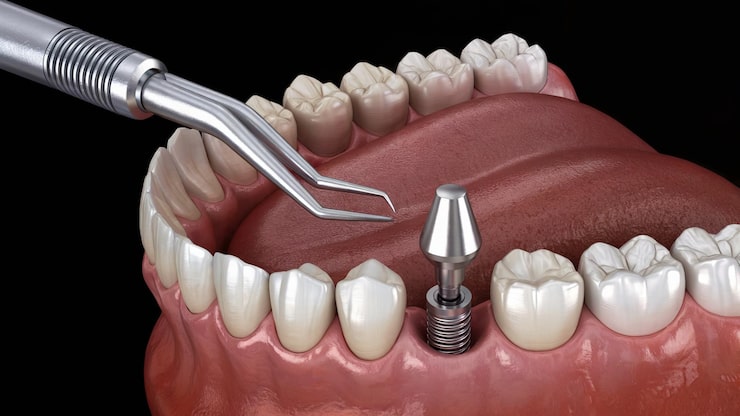
A dental implant is an artificial tooth root, usually a small titanium post, that is surgically placed into the jawbone to support a replacement tooth. Each implant has three parts: the post that anchors into the bone, an abutment connector, and a custom crown on top.
The word surgical simply reflects that placing the post is a minor oral surgery procedure. Unlike dentures or dental bridges, implants replace the tooth root rather than just the visible tooth. That is the key difference: because the post stimulates the jawbone the way a natural root does, implants help prevent the bone loss that normally follows a missing tooth. Bridges also require altering the neighboring teeth, while implants stand on their own.
Am I a Candidate for Dental Implants?
Most healthy adults with one or more missing teeth are candidates. You may be a good fit if the following apply:
| ✓ Adequate jawbone density to support the implant
✓ Healthy gums with no active gum disease ✓ Good general health and normal healing ability ✓ A fully developed jaw, so typically adults rather than teens ✓ Non-smoker, or willing to stop during healing ✓ Committed to good oral hygiene and follow-up visits |
Some patients need preparation first. About half of implant patients require some bone grafting, usually because bone has shrunk after a tooth was lost. Active gum disease must be treated before surgery, since implants need a healthy foundation. Uncontrolled diabetes, certain medications, and smoking all slow healing and raise the risk of failure, so your dentist reviews your medical history carefully before recommending treatment.
The Surgical Dental Implant Procedure: Step by Step
Implant treatment unfolds in stages, with healing time between them. Here is the full sequence.
Step 1: Consultation and 3D Imaging
Your dentist examines your mouth, reviews your medical history, and takes a 3D cone beam scan to map your bone volume, nerve position, and sinus location. This scan is what makes precise placement possible, and it typically costs $100 to $350 as part of the workup. Treatment is planned digitally before anything is done.
Step 2: Tooth Extraction, If Needed
If the damaged tooth is still in place, it is removed first. This may be a simple extraction or a surgical one, depending on whether the tooth is broken or impacted. Our guide to simple and surgical extractions in Lowell explains the difference. Extraction generally adds $150 to $450 and, in many cases, several weeks of healing before the site is ready.
Step 3: Bone Grafting, If Needed
When the jawbone is too thin or has resorbed, a graft rebuilds the foundation. Grafting typically costs $500 to $3,000 depending on the extent, and a sinus lift for upper back teeth runs higher. This is the single biggest timeline factor, since a graft needs roughly three to six months to integrate before the implant can be placed.
Step 4: Implant Placement Surgery
The titanium post is placed into the jawbone through a small incision. A single implant usually takes about 30 to 60 minutes and is performed under local anesthesia, with sedation available for anxious patients. Most people are surprised by how routine it feels and report less discomfort than an extraction.
Step 5: Osseointegration and Healing
This is where most of the time goes. Over three to six months, bone grows around and fuses to the implant, a process called osseointegration. Lower jaw implants often integrate faster, around three to four months, while upper jaw implants typically take four to six. A temporary tooth can usually be worn during this period. This biology cannot be rushed, and it is what gives implants their strength.
Step 6: Abutment Placement
Once the implant has integrated, the abutment connector is attached to the post. This is a minor procedure, and the gum tissue is allowed to heal around it for a couple of weeks before the final impression is taken.
Step 7: Custom Crown Placement
Your custom crown is fabricated to match your surrounding teeth in shape and shade, then secured to the abutment. This usually takes two to three weeks from impression to placement. At this point your implant looks and functions like a natural tooth.
How Long Does the Full Process Take?
Timelines vary considerably depending on complexity:
| Treatment Type | Typical Total Timeline | Main Variables |
| Single implant, no prep needed | 3 to 5 months | Healing and osseointegration |
| Single implant with extraction | 5 to 8 months | Extraction site healing first |
| Implant with bone graft | 9 to 12 months | Graft integration adds 3 to 6 months |
| Multiple implants | 4 to 9 months | Can often be placed in one surgery |
| Full arch (All-on-4 style) | 6 to 12 months | Temporary teeth same day, final later |
Factors that speed things up include good bone density, healthy gums, non-smoking status, and no need for extraction or grafting. Factors that extend treatment include grafting, infection at the site, smoking, uncontrolled diabetes, and complex cases involving several teeth.
Surgical Dental Implant Cost in Lowell (2026)
A single dental implant in Massachusetts typically costs $3,000 to $6,000 in 2026, including the post, abutment, and crown. Massachusetts and the wider Northeast run roughly 15 to 25 percent above the national average, so expect Boston-area and Merrimack Valley pricing toward the higher end of national ranges.
| Component | Typical Cost Range | Included in Base Quote? |
| Implant post (titanium) | $1,800 to $2,500 | Usually yes |
| Abutment (connector) | $300 to $700 | Usually yes |
| Crown (visible tooth) | $1,200 to $2,500 | Usually yes |
| 3D CBCT scan | $100 to $350 | Sometimes separate |
| Tooth extraction | $150 to $450 | Separate |
| Bone graft | $500 to $3,000 | Separate |
| Sinus lift | $1,500 to $3,000 | Separate |
| Sedation | $500 to $2,000 | Separate |
General Massachusetts market ranges from 2026 cost data, not Smiley Dental fees. Your cost is quoted after an exam and imaging.
Two honest warnings about quotes. First, a headline price like $1,500 per implant usually refers to the post alone, not the abutment and crown you also need. Second, because roughly half of patients need a graft or other site preparation, final bills often land 30 to 40 percent above the initial figure. Always ask for an itemized written estimate. For a fuller local breakdown, see our Lowell dental implant cost guide and implant crown cost guide. Full-arch treatment such as All-on-4 runs considerably higher, generally $21,000 to $38,000 per arch in Massachusetts.
Does Insurance Cover Dental Implants in Massachusetts?
Partially, in most cases. Many Massachusetts PPO plans cover around 50 percent of the implant crown as major restorative work, often after a six to twelve month waiting period, capped by your annual maximum of roughly $1,500 to $2,500. The implant post itself is frequently excluded.
A few practical points. Extractions and bone grafts are sometimes covered separately even when the implant is not. Implants are billed under specific procedure codes, so your office can run a pre-treatment estimate to confirm coverage before you commit. One legitimate strategy is staging treatment across two benefit years, completing extraction and grafting late in one year and placement the next, which can tap two annual maximums. MassHealth generally excludes implants unless medically necessary. Our guide to dental procedures covered by insurance explains how coverage tiers work.
How Can I Get Dental Implants If I Can’t Afford Them?
Implants are a significant investment, but there are legitimate ways to make them manageable.
- Phase the treatment across two insurance benefit years to use two annual maximums.
- Ask about financing through options like CareCredit or Cherry to spread payments monthly.
- Consider dental schools, since Tufts, Harvard, and BU offer supervised care at reduced rates with longer timelines.
- Explore alternatives, since a bridge or partial denture may serve your situation at lower cost.
It is worth comparing options carefully rather than assuming implants are the only answer. Our overview of alternatives to dental implants and the implant versus bridge cost comparison lay out the trade-offs. Ask any office for a written estimate and payment options before deciding.
Recovery and Aftercare: What to Expect
Most patients find implant recovery easier than expected. Swelling typically peaks around day two or three, and most people return to normal daily activities within 24 to 72 hours.
- Days 1 to 7. Mild swelling and soreness, managed with over-the-counter pain relief. Stick to soft foods and use cold compresses early on.
- Weeks 2 to 4. Gum tissue closes and any sutures are removed. Comfort returns and you can gradually resume normal eating.
- Months 3 to 6. Osseointegration completes beneath the surface, usually with no symptoms at all.
Contact your dentist promptly if you have increasing rather than decreasing pain after the first few days, swelling that worsens after day three, fever, persistent bleeding, a bad taste or discharge, or if the implant feels loose. These can indicate infection or a problem with integration.
Long term, implants need the same care as natural teeth: brushing, cleaning between teeth, and regular checkups. The post itself can last 20 years or more, often a lifetime, while the crown typically needs replacing after 10 to 15 years. Our guide on how to care for dental implants covers the routine in detail.
What Is the Downside to Dental Implants?
Implants have a high success rate, generally above 95 percent in healthy patients, but they are surgery and it is fair to know the trade-offs.
- Cost, which is higher upfront than a bridge or denture and rarely fully covered by insurance.
- Time, since treatment spans months rather than weeks.
- Surgery and healing, with the usual risks of infection, bleeding, or delayed healing.
- Implant failure, uncommon but possible if the bone does not integrate properly.
- Nerve or sinus issues, rare and largely avoided through 3D imaging and careful planning.
- Bone requirements, meaning some patients need grafting first.
Higher-risk patients include smokers, people with uncontrolled diabetes, those who are immunocompromised, and patients with untreated gum disease. Smoking is the single biggest controllable risk factor. Risk is reduced through thorough screening, 3D planning that maps nerve and sinus position precisely, sterile surgical technique, and careful follow-up. A good provider will tell you plainly if you are not currently a good candidate.
Surgical vs Mini Dental Implants
Mini implants are a narrower alternative sometimes used when bone is limited or to stabilize a denture:
| Factor | Standard Surgical Implant | Mini Implant |
| Diameter | About 3.5 to 6 mm | Under 3 mm |
| Bone required | More, grafting sometimes needed | Less, often avoids grafting |
| Procedure | Incision and healing period | Less invasive, faster placement |
| Best for | Single teeth, bridges, full arches | Stabilizing dentures, narrow spaces |
| Durability | Very high, decades with care | Generally shorter lifespan |
Standard implants remain the more durable, versatile choice for most patients. Mini implants can be a practical option when bone volume is limited and grafting is not desirable. Your dentist recommends based on imaging rather than preference.
How Do I Find an Oral Surgeon in Lowell?
Rather than relying on a list that may be outdated, verify providers yourself. It takes very little time and gives you current information.
Start with the Massachusetts Board of Registration in Dentistry, which maintains a public license lookup confirming a provider is licensed and in good standing and showing any disciplinary history. The American Association of Oral and Maxillofacial Surgeons also offers a find-a-surgeon directory. Ask your general dentist for a referral, since they often work with specific surgeons and know who handles complex cases well. Note that many general dentists place implants themselves, and for straightforward cases that is entirely appropriate. Ask how many implants a provider places, what imaging they use, and who handles complications if one arises.
Why Choose a Local Lowell Provider?
Implant treatment involves multiple appointments across several months, plus follow-ups afterward. A nearby provider makes that considerably easier, particularly if a question comes up between visits or you need to be seen quickly.
Continuity matters too. A provider who handles your extraction, placement, and final crown knows your case throughout, rather than coordinating records between offices. Our Lowell dental office at 1141 Bridge Street offers implant treatment alongside restorative dentistry and general care, serving Dracut, Chelmsford, Tewksbury, and the Merrimack Valley.
Frequently Asked Questions
How much do dental implants cost in Lowell, MA?
A single implant typically costs $3,000 to $6,000 in Massachusetts, including the post, abutment, and crown. Bone grafting, extractions, sedation, and imaging are usually quoted separately. Since roughly half of patients need site preparation, ask for an itemized written estimate after your consultation and 3D scan.
Is dental implant surgery painful?
The procedure itself should not hurt, since it is performed under local anesthesia with sedation available. Afterward, most patients have mild soreness and swelling for a few days, managed with over-the-counter pain relief. Many describe it as more comfortable than a tooth extraction.
How long do dental implants last?
The titanium post often lasts 20 years or more and can last a lifetime with good care. The crown on top typically needs replacing after 10 to 15 years due to normal wear. Good oral hygiene, regular checkups, and not smoking make the biggest difference.
Can I get an implant the same day as an extraction?
Sometimes. Immediate placement is possible when there is enough healthy bone and no active infection at the site. Many cases still require the extraction site to heal first, particularly if grafting is needed. Your 3D scan and examination determine whether same-day placement is appropriate.
What is the difference between an implant and a bridge?
An implant replaces the tooth root and stands independently, helping preserve jawbone. A bridge sits on top of the gum and requires reshaping the neighboring teeth for support. Bridges cost less upfront and take weeks rather than months, but typically last 10 to 15 years versus decades for implants.
What is the average cost of a dental implant in Massachusetts?
Massachusetts averages $3,000 to $6,000 per single implant in 2026, higher than the national average because the Northeast runs roughly 15 to 25 percent above typical costs. Full-arch treatment such as All-on-4 generally runs $21,000 to $38,000 per arch.
Do I need a bone graft before getting an implant?
About half of implant patients do. Grafting is needed when the jawbone has thinned or resorbed after tooth loss, which is common when a tooth has been missing a while. It adds roughly $500 to $3,000 and three to six months to the timeline. Your 3D scan shows whether you need one.
Can smokers get dental implants?
Smokers can receive implants, but smoking is the single biggest controllable risk factor for failure because it impairs healing and blood flow to the surgical site. Many providers ask patients to stop before surgery and throughout healing. Discuss this openly with your dentist rather than omitting it.
What happens if a dental implant fails?
Failure is uncommon, occurring in under five percent of healthy patients, and usually happens either early when the bone does not integrate or later from infection around the implant. The implant is typically removed, the site allowed to heal, and replacement is often possible after grafting. Early symptoms include looseness, persistent pain, or swelling.
The Bottom Line
Surgical dental implants replace a missing tooth root with a titanium post that supports a custom crown, and in Massachusetts, a single implant typically costs $3,000 to $6,000 in 2026. Most of the three- to nine-month timeline is healing rather than appointments, since the bone needs three to six months to fuse with the implant. Extraction or bone grafting extends that, and roughly half of patients need some site preparation, which is why itemized estimates matter.
Implants are not right for everyone, and a bridge or denture may suit your situation and budget better. The way to know is an examination with 3D imaging and an honest conversation about options. To discuss whether implants make sense for you, contact Smiley Dental Lowell at 1141 Bridge Street. Call 978-999-9000 or request an appointment online.
| Book an implant consultation
Smiley Dental Lowell, 1141 Bridge Street, Lowell, MA. Call 978-999-9000 to discuss your options. We can verify your insurance benefits and explain available financing before treatment begins, so you know your costs upfront. |