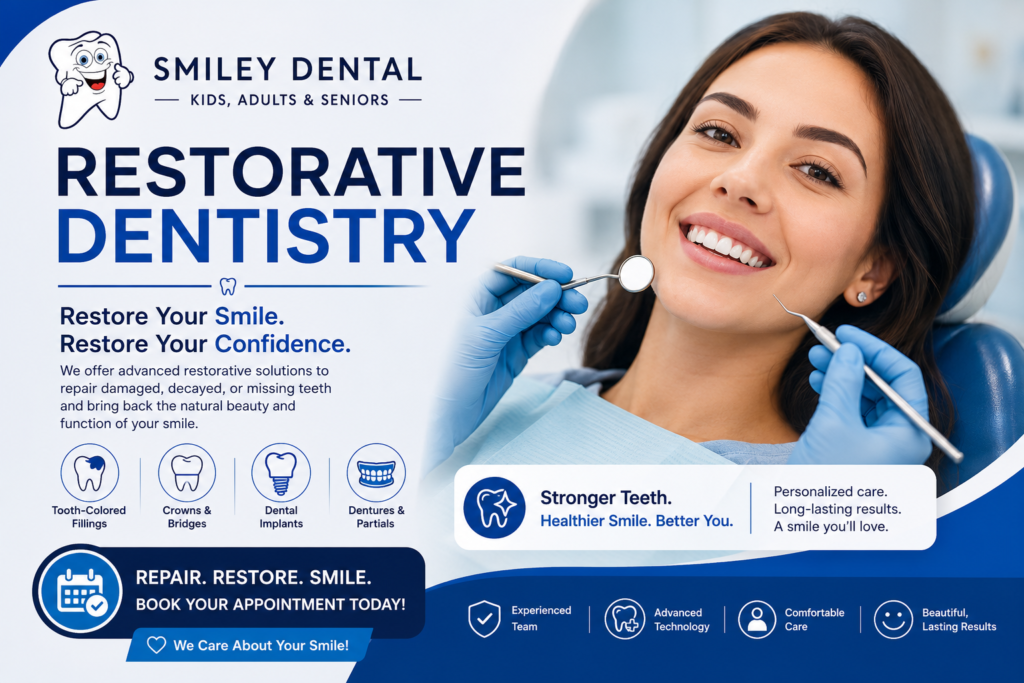
Restorative dentistry repairs or replaces damaged and missing teeth. For retired patients in Lowell, it restores comfortable chewing, clearer speech, and a natural-looking smile. Common options include fillings, crowns, bridges, dentures, and dental implants. The right choice depends on your oral health, jawbone, and goals, and a dentist helps you decide during a simple exam and consultation.
- What Is Restorative Dentistry?
- Why Do Retired Patients Often Need Restorative Dentistry?
- What Are the Best Restorative Options for Retired Patients?
- Dental Implants vs Dentures vs Bridges
- How Do Dentists Choose the Right Treatment?
- Signs It’s Time to Visit a Restorative Dentist
- How Untreated Dental Problems Get Worse Over Time
- What Can Patients Expect During Treatment?
- Benefits of Restorative Dentistry for Retired Patients
- How to Care for Your Dental Restorations
- Why Patients Choose Smiley Dental Lowell
- The Bottom Line
Getting older does not have to mean losing your teeth or your confidence. Many retired adults in the Lowell area deal with worn, cracked, or missing teeth, and modern dentistry has a comfortable answer for each.
This guide walks through the main options in plain language, so you or a loved one can feel prepared before visiting a dentist. The goal is to help you make an informed choice, not to push any single treatment.
What Is Restorative Dentistry?
Restorative dentistry is the branch of dental care that repairs or replaces damaged or missing teeth. It brings back the function and health of your mouth, so you can eat, speak, and smile with ease. Restorative dental care ranges from a small filling to a full set of teeth.
It differs from cosmetic dentistry, which focuses on appearance. Restorative work is about health and function first, though results usually look natural too. When a tooth is repaired, your bite improves and your other teeth are protected.
Common procedures include fillings, crowns, bridges, dentures, and implants, and we cover them all below.
Why Do Retired Patients Often Need Restorative Dentistry?
Teeth take decades of daily use, so it is normal for older adults to need repair work. Several things add up over time:
- Natural wear: years of chewing gradually thin the enamel.
- Missing teeth: lost to decay, gum disease, or injury.
- Old restorations wearing out: older fillings and crowns can crack or leak.
- Gum disease: a leading cause of tooth loss in older adults.
- Bone loss: missing teeth let the jawbone shrink over time.
- Dry mouth from medications: less saliva raises decay risk.
- More brittle teeth: older teeth crack more easily.
What Are the Best Restorative Options for Retired Patients?
There is no single best option, only the best fit for you:
Tooth-Colored Fillings
Best for small cavities, chips, and replacing old metal fillings. Tooth-colored fillings are quick, blend in, and preserve more of the natural tooth.
Dental Crowns and Bridges
A crown caps a cracked, worn, or heavily filled tooth to restore its strength, while a bridge replaces one or a few missing teeth using the neighboring teeth for support. Crowns and bridges are color-matched to look natural, and a bridge is fixed, so it does not come out.
Partial and Full Dentures
Best for replacing several or all missing teeth. Modern dentures fit better and look more natural than older ones. A partial fills in gaps, while a full denture replaces a complete arch.
Dental Implants
Best for the most durable replacement. Dental implants are titanium posts placed in the jaw that act like natural roots. They also preserve the jawbone, which other options do not.
Implant-Supported Dentures
Best for denture wearers who want more stability. A few implants anchor the denture so it does not slip while you eat or talk, which many retirees find the most comfortable way to replace a full arch.
Full Mouth Restoration
Best when many teeth need attention at once. A full mouth restoration combines several treatments into one plan, with the most urgent needs first.
Dental Implants vs Dentures vs Bridges
These are the three main ways to replace missing teeth.
| Factor | Implants | Bridges | Dentures |
|---|---|---|---|
| Appearance | Most natural | Very natural | Natural |
| Comfort | Feels like real teeth | Fixed and stable | May need adjusting |
| Durability | 20+ years, often lifelong post | 10 to 15 years | 5 to 10 years |
| Maintenance | Brush and floss as normal | Special flossing | Remove and clean daily |
| Cost | Highest upfront | Moderate | Lowest upfront |
| Bone health | Preserves jawbone | Does not preserve bone | Does not preserve bone |
| Best for | Healthy gums and bone | A few teeth in a row | Several or all teeth |
Lifespans are typical ranges and depend on your care, bite, and follow-up visits. Your dentist gives you specifics for your case.
How Do Dentists Choose the Right Treatment?
A good dentist weighs several things before recommending anything. The choice is always personal:
- Your overall oral health, including any gum disease
- How many teeth are missing or damaged
- The health of your jawbone
- Your budget and insurance coverage
- Your lifestyle, goals, and daily habits
- Your medical history and any medications
For example, an implant needs healthy jawbone, while a denture may suit someone who prefers a simpler, lower-cost path. There is a good option at every stage.
Do not wait for pain. Book a visit if you notice any of these:
Difficulty chewing or biting, a cracked or broken tooth, a missing tooth or a growing gap, a loose or ill-fitting denture, ongoing tooth sensitivity, an old filling or crown that feels rough or loose, or gums that bleed or pull away from the teeth. Catching these early keeps treatment simpler.
How Untreated Dental Problems Get Worse Over Time
Small dental problems rarely stay small, and understanding what happens when you wait makes the case for acting early.
A tiny cavity spreads deeper into the tooth. Once it reaches the nerve, a simple filling becomes a root canal or an extraction. A small crack widens until the tooth splits and cannot be saved.
Missing teeth cause a chain reaction. Nearby teeth drift into the gap, the opposite tooth over-erupts, and your bite falls out of line. The jawbone there also shrinks, which can change your facial shape.
Gum disease left untreated destroys the bone that holds your teeth. This is why we treat gum health first, often with periodontal care, before placing any restoration. The lesson is consistent: early care is simpler, more comfortable, and less costly.
What Can Patients Expect During Treatment?
Knowing the steps ahead of time makes the process feel manageable:
- Comprehensive exam. The dentist checks your teeth, gums, bite, and existing dental work.
- Digital X-rays. These show the roots, bone, and anything hidden below the surface.
- Personalized plan. You get clear options, a timeline, and a written estimate, with pros and cons explained.
- Treatment. Urgent needs like pain or infection come first, then the definitive restorations. Temporaries keep you comfortable between visits.
- Recovery. Most treatments have little downtime; your dentist explains what to expect.
- Follow-up. We check the fit and your bite, then set a schedule to keep everything healthy.
Benefits of Restorative Dentistry for Retired Patients
Restoring your teeth affects more than your smile. Patients often notice:
- Easier, more comfortable chewing
- Clearer speech
- Better nutrition from a wider range of foods
- Less pain and sensitivity
- Healthier gums and a more stable bite
- More confidence and a natural-looking smile
Good chewing supports good nutrition, and good nutrition supports overall health, which is why dental care matters so much later in life.
How to Care for Your Dental Restorations
Restorations last longest with simple, steady care:
- ✓ Brush twice a day with fluoride toothpaste
- ✓ Floss once a day, including around crowns, bridges, and implants
- ✓ Clean dentures daily and soak them overnight as directed
- ✓ Avoid chewing ice, hard candy, and very hard foods
- ✓ Wear a night guard if you grind your teeth
- ✓ Keep regular cleanings and checkups, usually twice a year
- ✓ Stay hydrated, especially if you have dry mouth
Why Patients Choose Smiley Dental Lowell
Where you have restorative work done matters as much as the treatment. Here is what our Lowell patients value:
- An experienced dental team, trained at Harvard, Boston University, the University of Michigan, and other respected schools, including dentists certified in placing implants.
- Personalized treatment plans built around your goals, timeline, and budget.
- Comprehensive care, from a single filling to full mouth restoration, all in one place.
- Modern dental technology, including digital X-rays for accurate diagnosis.
- A comfortable experience, with gentle care and a calm environment.
- A convenient Lowell location at 1141 Bridge St, serving Dracut, Chelmsford, Tewksbury, Billerica, and Tyngsborough.
Our team speaks several languages, including English, Spanish, and Portuguese, and we have been recognized among America’s Best dentists in recent years. We explain your options honestly so you can decide with confidence.
The Bottom Line
Restorative dentistry gives retired patients a real path back to comfortable eating, clear speech, and a smile they feel good about. Whether you need a single crown or a full set of new teeth, there is a treatment suited to your health, goals, and budget. Acting early keeps care simpler and protects the teeth you still have.
The best first step is a conversation. A dentist can examine your mouth, explain your options in plain language, and help you choose what fits your life. You do not need it all figured out before you call.
Schedule a consultation at Smiley Dental Lowell to discuss the restorative options that best fit your needs. Call 978-999-9000, request an appointment online, or contact our Lowell office at 1141 Bridge St. New patients are always welcome.