Did you know that modern root canal treatments now boast a success rate as high as 99%? Despite this impressive reliability, many patients still feel anxious about the root canal recovery time and tips they’ll need to follow to stay comfortable. It’s completely normal to worry about lingering pain or feel confused about what counts as a typical healing response versus something that requires a professional check-in.
We’re here to replace that uncertainty with a clear, supportive roadmap for your healing journey. You’ll learn exactly how the recovery process unfolds across three predictable phases and gain expert insights into managing discomfort at home. We’ll also explain how a follow-up crown works to protect your tooth, ensuring your smile remains strong, healthy, and entirely pain-free for years to come.
Key Takeaways
- Understand the difference between the initial “healing ache” of surrounding tissues and the permanent relief from your original toothache.
- Navigate your healing journey with a clear day-by-day root canal recovery time and tips to manage the peak sensitivity window effectively.
- Learn to distinguish between normal jaw tenderness from the procedure and signs that require a quick follow-up with your dental team.
- Discover proactive strategies for a comfortable recovery, including effective anti-inflammatory approaches and a “soft food” diet that doesn’t sacrifice flavor.
- See how advanced VideaHealth AI diagnostics and porcelain crowns work together to ensure your tooth remains strong and healthy for years.
What is Root Canal Recovery? Setting Realistic Expectations
Root canal recovery is the essential period where your surrounding gum and bone tissue heal after your dentist removes the internal infection. Think of it as a vital transition phase. While the Root canal treatment itself is designed to eliminate the source of your agony, your body needs a moment to reset. The goal of this process is simple: moving you from emergency relief to a fully functional, healthy smile that feels natural again.
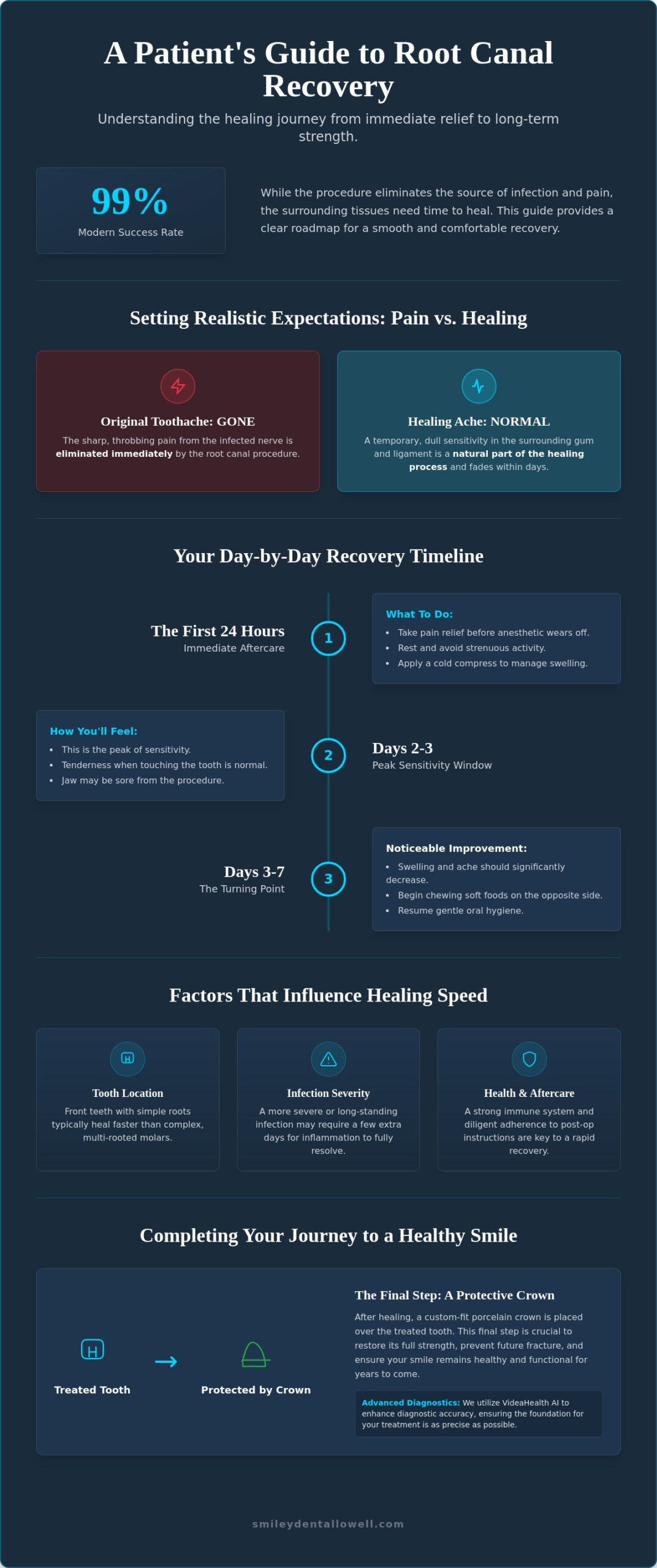
Many people worry about the “pain” of a root canal, but this is largely a misunderstanding. Because the procedure removes the infected nerve, the sharp, throbbing toothache you walked in with ends immediately. However, a “healing ache” typically takes its place for a few days. This isn’t the same as an active infection; it’s just your body’s natural way of repairing the area. Understanding the root canal recovery time and tips for management can help you stay calm and comfortable during this brief window.
The Difference Between Procedure Pain and Healing Sensitivity
During the first 48 hours, you’ll likely feel pressure rather than sharp pain. When the local anesthetic wears off, you might notice a dull sensation as your body begins the repair work. Root canal recovery is an inflammatory response of the periodontal ligament. This ligament holds your tooth in place. Because it was handled during the procedure, it stays a bit sensitive for a short while. You’ll notice this most if you accidentally bite down too hard or touch the tooth with your tongue, but this sensitivity fades quickly as the inflammation subsides.
Factors That Influence Your Personal Healing Speed
Your recovery timeline isn’t a one-size-fits-all experience. Several factors play a role in how quickly you’ll feel 100% again. Recovery time varies significantly based on where the tooth is located. A front tooth is generally easier for the body to process because the root structure is simple and usually contains only one canal. In contrast, molars are the workhorses of your mouth. They have multiple roots and complex canal systems, which means the surrounding bone and gums have a bit more work to do during the healing phase.
Your overall health also matters. A strong immune system helps speed up tissue regeneration. If you’ve been dealing with a severe, long-term infection, your body may take a few extra days to clear out the residual inflammation. Following your post-op instructions is the most important variable in how fast you’ll feel like yourself again. By staying proactive with your care, you’ll find that the root canal recovery time and tips shared by your dental team make the process feel quick and manageable. The ultimate objective is to save your natural tooth, preparing it for a final porcelain crown that will keep your smile strong for years to.
Your Day-by-Day Root Canal Recovery Timeline
Once your procedure is finished, the healing process follows a predictable, steady path toward comfort. Knowing what to expect regarding your root canal recovery time and tips for managing each stage can turn a stressful week into a manageable one. Most patients find that their journey involves a few days of adjustment followed by a rapid return to their normal routine as the treated area stabilizes.
The First 24 Hours: Immediate Aftercare
Managing the first 24 hours is all about proactive care. It’s a smart move to take your first dose of recommended pain relief before the local anesthetic completely wears off. This keeps you ahead of any discomfort as the numbness fades. For our neighbors in Lowell, whether you’re navigating a shift at one of the local healthcare facilities or managing a busy schedule at a nearby university, we suggest planning for a quiet afternoon. Avoid the gym or heavy lifting; keeping your heart rate steady helps minimize any initial throbbing in the jaw. For a deeper look at how the procedure works, you can read this Root Canal Explained resource from the American Association of Endodontists.
Days two and three are often the peak of sensitivity. You might notice some tenderness when your tongue touches the tooth or when you close your mouth. This is the most critical time for rest. Your body is working hard to resolve the inflammation that existed before the treatment. If you ever feel concerned about your progress or have questions about your specific situation, our team at Smiley Dental Lowell is always here to provide reassurance and guidance.
Days 3 to 7: The Turning Point
By the fourth day, you should notice a significant turning point. Swelling should begin to decrease, and the dull ache in your jaw from holding your mouth open during the visit should fade. You can start gradually reintroducing solid foods, though it’s still best to chew on the opposite side of your mouth to protect the temporary filling. Gentle oral hygiene is vital during this stage. Brush carefully around the treated area, but don’t skip it; keeping the site clean prevents irritation and secondary infections.
Following these root canal recovery time and tips ensures that by the end of the first week, you feel nearly back to normal. You’ll then be ready for the final step in your journey. We usually schedule the placement of your permanent porcelain crown for week two or three. This restoration is essential because it fully restores the tooth’s strength and protects it from future fractures, allowing you to eat and smile with total confidence once again.
Is This Normal? Recognizing Healing vs. Potential Complications
It’s natural to pay close attention to every sensation in your mouth after a dental procedure. You might find yourself wondering if that little twinge is part of the standard root canal recovery or a sign of a problem. Most of the time, what you’re feeling is just your body doing its job. Mild tenderness when you bite down or a dull ache in your jaw from keeping your mouth open is perfectly normal. These sensations usually peak around the second day and then steadily fade as inflammation subsides.
However, knowing the difference between healing and a complication is key to your peace of mind. While we want you to feel relaxed, there are a few red flags that mean you should give us a call. If you notice visible swelling on your gums or the outside of your face that gets worse after the third day, that’s not typical. Similarly, if the sharp, throbbing pain you had before the procedure suddenly returns, it’s time for a professional check-in. Staying informed about root canal recovery time and tips helps you stay ahead of these rare issues and ensures your tooth is on the right track.
The ‘High Bite’ Issue: A Common but Easy Fix
Sometimes, the most intense post-op pain isn’t caused by the root canal itself, but by the temporary filling. If that filling is just a fraction of a millimeter too tall, it hits the opposite tooth before any other teeth do. This puts immense pressure on the healing ligament every time you close your mouth. A misaligned bite is the most frequent cause of post-op discomfort. If your tooth feels “high” or prevents your other teeth from touching properly, a quick visit to our Lowell office for a simple adjustment can provide near-instant relief.
When to Call for Emergency Dental Care in Lowell
We take your comfort seriously and prioritize our post-op patients for emergency dental care in Lowell. If your temporary filling falls out entirely, don’t panic, but do call us so we can replace it and protect the site from bacteria. It is also important to distinguish between a dental issue and an allergic reaction. If you experience a rash, hives, or difficulty breathing after taking a new medication, seek medical help immediately. For standard dental concerns, our team is always here to ensure your root canal recovery time and tips lead to a healthy, happy outcome.
Expert Tips for a Faster, More Comfortable Recovery
A smooth healing process is often the result of small, intentional choices you make at home. While your body does the heavy lifting of tissue repair, you can significantly influence your root canal recovery time and tips like these are designed to keep you ahead of any discomfort. One of the most effective strategies is a proactive anti-inflammatory approach. Using over-the-counter options as recommended by your dentist helps manage swelling before it starts, keeping the area calm and relaxed during those first critical hours.
Rest is just as vital as medication. During the first night, try to keep your head elevated with an extra pillow. This simple trick reduces blood pressure in the head, which helps minimize that rhythmic throbbing sensation that sometimes occurs after dental work. Additionally, a gentle saltwater rinse starting 24 hours after your visit acts as a natural disinfectant. It keeps the site clean and soothes gum irritation without the harshness of alcohol-based mouthwashes, making it a perfect local remedy for Lowell residents.
What to Eat and What to Avoid
Your “Root Canal Diet” doesn’t have to feel like a sacrifice. The goal is to avoid putting pressure on the temporary filling while providing your body with the nutrients it needs to heal. Focus on soft, easy-to-chew options that are gentle on your jaw. Greek yogurt, lukewarm mashed potatoes, scrambled eggs, and nutrient-dense smoothies are all excellent choices that keep you full without causing irritation.
On the other hand, you should stay away from the “danger zone” of foods for at least a week. Steer clear of crunchy chips, sticky candies, or crusty breads that could dislodge your temporary restoration or get trapped in the gums. It’s also wise to avoid very hot or ice-cold beverages for the first few days, as the area may be sensitive to thermal changes. When you do eat, practice “safe chewing” by using the side of your mouth opposite the treated tooth to protect the site until your permanent crown is placed.
Optimizing Your Home Environment for Healing
Your surroundings play a major role in how you feel. For the first 24 hours, applying a cold compress to the outside of your cheek in 15-minute intervals can work wonders for minimizing external swelling. It is also a great time to focus on hydration. Your body requires extra water and fuel to regenerate tissue and clear out the residual inflammation from the previous infection. A calm mind often leads to a faster physical recovery. Stress can increase your sensitivity to pain, so give yourself permission to relax with a favorite book or movie.
If you’re looking for more personalized advice on your root canal recovery time and tips for your specific case, don’t hesitate to contact our friendly team at Smiley Dental Lowell today. We’re here to support every step of your journey toward a healthy, pain-free smile.
Completing Your Journey at Smiley Dental Lowell
At Smiley Dental Lowell, we believe that a successful recovery starts with a precise procedure. That’s why we utilize VideaHealth AI diagnostics to ensure your treatment is thorough from the very first step. This advanced technology helps our team identify even the smallest canal structures with incredible accuracy, which significantly reduces the risk of post-operative complications. By getting it right the first time, we help you stay on track with your root canal recovery time and tips for a healthy, vibrant smile.
We also understand that part of a truly stress-free experience is having clarity about the administrative side of your care. Navigating dental insurance in Lowell shouldn’t be a headache. Our administrative team works closely with you to maximize your benefits for restorative procedures. We take pride in being a transparent and compassionate partner, ensuring that your follow-up care is as affordable as it is effective. Our goal is to provide gentle, family-oriented dentistry that makes every member of your household feel welcome and well-cared for.
Why the Final Crown is the Most Important Step
Once the internal infection is cleared and the tooth is sealed, it enters a new phase of life. It’s important to understand that a root-canaled tooth is naturally more brittle because it no longer has a live blood supply. Without a final restoration, the tooth is at a higher risk for fractures or leaks. This is why we prioritize high-quality porcelain crowns in Lowell as the definitive solution for long-term survival.
These crowns provide the essential structural support needed for everyday chewing and speaking. Beyond the functional benefits, our porcelain restorations offer beautiful aesthetic results. We carefully match the shape and shade of the crown to your natural teeth, ensuring your smile looks seamless and bright. It is the final piece of the puzzle that turns a clinical necessity into a lasting, beautiful result.
Stress-Free Scheduling and Financial Flexibility
Our commitment to the community extends beyond clinical excellence to include physical and financial peace of mind. We offer flexible payment options for patients without insurance in the Greater Lowell area, making professional restorative care accessible for everyone. We believe that high-quality dentistry should never be out of reach. Our team is dedicated to helping you manage your root canal recovery time and tips for home care so you can return to your busy life without lingering dental stress.
Whether you’re finishing a treatment or just starting your journey toward better oral health, we’re here to advocate for you. We maintain a steady, encouraging rhythm of care from your first exam to your final crown placement. Schedule your follow-up or consultation at Smiley Dental Lowell today and discover how our modern practice keeps the neighborly touch in every appointment.
Take the Next Step Toward Your Healthy, Confident Smile
You’ve discovered that root canal healing is a predictable, manageable journey when you have the right information. By understanding the phases of healing and staying proactive with your home care, you can significantly shorten your recovery. Following the root canal recovery time and tips we’ve shared, like keeping your head elevated and choosing soft foods, helps you transition quickly from toothache relief to a fully restored, healthy smile.
Our team is dedicated to making professional care accessible and stress-free for everyone in the Lowell community. We utilize AI-enhanced VideaHealth diagnostics for precision treatment, ensuring your procedure is thorough and accurate the first time. We accept most major insurance plans and provide emergency dental appointments in Lowell to address any urgent needs that arise. We’re here to advocate for both your health and your financial peace of mind, providing a neighborly touch to modern dental care.
Schedule Your Root Canal Consultation at Smiley Dental Lowell
We’re excited to help you achieve the comfortable, pain-free smile you deserve and look forward to welcoming you to our family practice soon.
Frequently Asked Questions
How long does it take for a root canal to stop hurting?
Most patients find that the sharp, throbbing pain disappears immediately after the procedure is finished. However, a dull “healing ache” or sensitivity to pressure is normal for about two to four days while tissues settle. This is just your body’s natural, healthy response to the treatment. If you follow our recommended root canal recovery time and tips, you’ll likely feel completely back to normal within a single week.
Can I go back to work the day after a root canal?
You can typically return to work or school the very next day without any issues. Most people feel well enough to resume their normal routine once the initial numbness wears off completely. If your job involves heavy physical labor or intense cardio, we suggest taking it easy for at least 24 hours. This prevents increased blood flow to the head, which can sometimes cause a temporary increase in jaw throbbing or sensitivity.
What happens if I don’t get a crown after my root canal?
Skipping the permanent crown puts your tooth at a very high risk of fracturing during normal use. Because a root-canaled tooth no longer has a live blood supply, it becomes more brittle over time. A porcelain crown provides the structural “helmet” needed to withstand the daily pressure of chewing. Without this protection, the tooth could split or suffer a new infection, potentially leading to the need for a tooth extraction.
Is it normal to have a ‘pimple’ on the gums after the procedure?
A small bump or “pimple” on the gums, often called a fistula, is not a normal part of the healing process. It usually indicates a lingering infection or an abscess that needs professional attention right away. While minor, generalized swelling is common in the first 48 hours, a localized bump should be reported to our office. We’ll use digital X-rays to check the area and ensure your healing is progressing safely.
How should I sleep after a root canal to reduce pain?
Keeping your head elevated with an extra pillow is the most effective way to sleep after your visit. This simple adjustment prevents blood from pooling in your head, which significantly reduces the pressure and throbbing sensation in your jaw. Many patients find that staying upright for the first night makes their root canal recovery time and tips much more effective. This proactive step leads to a more restful and comfortable night’s sleep overall.
Can I smoke or use a straw during root canal recovery?
We strongly advise avoiding smoking and using straws for at least 24 to 48 hours after your procedure. The suction created by using a straw can disturb the temporary filling or irritate the healing gum tissue. Smoking introduces chemicals that constrict blood vessels and slow down the body’s natural repair process. For the fastest results, give your mouth a clean, suction-free environment to focus entirely on regenerating healthy, new tissue.
Why does my jaw hurt more than the actual tooth after the visit?
Jaw muscle soreness is very common because your mouth was held open for an extended period during the root canal visit. You might also feel tenderness at the site where the local anesthetic was administered. This muscular discomfort often feels more prominent than any sensation in the tooth itself. Applying a warm compress to the outside of your jaw on the second day can help relax these muscles and provide quick, soothing relief.
What if my temporary filling feels loose or falls out?
If your temporary filling feels loose or falls out, please call our Lowell office right away so we can help. While it is not a medical emergency, the filling is there to prevent bacteria from re-entering the cleaned root canals. If you can’t come in immediately, avoid chewing on that side to keep the area as clean as possible. We’ll schedule a quick visit to replace the seal and keep your recovery on track.